Imagine opening the Ethiopian Bible to the Books of Maccabees expecting a familiar story.
In the Catholic and Eastern Orthodox traditions, Maccabees means one thing: the Hasmonean revolt against the Seleucid Empire in the 2nd century BC. Judas Maccabeus leading a guerrilla war against Antiochus IV. The cleansing of the Jerusalem temple. The origin of Hanukkah.
Open the Ethiopian Bible to Meqabyan, and none of that is there.
The First Book: A Family Refuses
Instead you find a Benjaminite named Meqabis and a tyrant king named Tsirutsaydan who orders his subjects to worship idols. Meqabis and his sons refuse, arguing that a god of wood and stone cannot be compared to the one true Creator.
The king answers with torture and fire. The sons meet their deaths insisting on resurrection and divine justice, in scenes that echo both Daniel's three companions in the furnace and the martyrdoms of 2 Maccabees.
The Second and Third Books
That is only 1 Meqabyan. The second tells a different story: a Moabite king, also named Meqabis, who makes war on Israel, has a change of heart, and ends up instructing the Israelites in God's law. The third is shorter, a set of moral exhortations built around figures including Adam, Job and David, turning on punishment, salvation and perseverance.
Where the Name Actually Comes From
None of the three has a historical connection to the Hasmonean revolt. No Judas Maccabeus. No Antiochus IV. No Maccabean dynasty at all.
The books were composed in Ge'ez. Their authorship is unknown and their date is not settled, but linguistic analysis has led scholars to place them early in the life of the Ethiopian church, commonly in the 4th or 5th century, with some proposals tying 1 Meqabyan to the circle of Frumentius. The name borrows the fame and the meaning of "Maccabee," faithful resistance under persecution, and builds a new set of stories on it, shaped by Ethiopian Christian concerns about idolatry and resurrection rather than by a Hellenistic war fought centuries earlier and thousands of miles away.
Why a church would compose its own Maccabees instead of translating the existing ones is not recorded anywhere, so any answer is inference rather than fact. The common scholarly reading is that a young Christian community under its own pressures wanted stories of unbreakable faith in its own language, addressed to its own questions.
Whatever the reason, the result is three books canonical only in the Ethiopian and Eritrean Orthodox Tewahedo churches, and not widely available to English readers until recent decades.
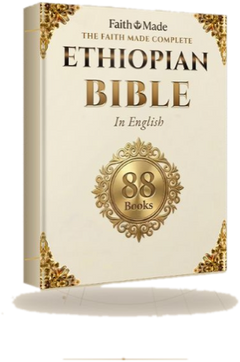
The Faith Made Complete Ethiopian Bible includes all three books of Meqabyan in English, inside an 88-book edition.
A note on names, because it trips people up: Meqabyan and the Greek Maccabees are separate works. Our edition carries 1, 2 and 3 Meqabyan. It does not contain 1 and 2 Maccabees. It does carry twelve of the fourteen books the 1611 King James printed.
Where this comes from. A plain-language summary of published historical scholarship. Ancient dates and counts are reconstructions, and where scholars disagree this article says so.