When the disciples asked Jesus privately what the sign of his coming would be, he gave them a long answer. Wars and rumours of wars. Famines. False prophets. A warning not to be deceived.
Then he did something easy to read past. He anchored the whole thing to a specific period in the past.
"But as the days of Noe were, so shall also the coming of the Son of man be." (Matthew 24:37)
He is saying: if you want to know what the end looks like, go study what that era looked like. Which raises an obvious question. How much does your Bible actually tell you about it?
Four Verses
Turn to Genesis 6. The passage runs from verse 1 to verse 4. Sons of God, daughters of men, and a line that has troubled readers for two thousand years: "There were giants in the earth in those days."
Then the text moves straight on to the flood. No explanation of who the sons of God were. No account of what they did. No follow-up. It is one of the most consequential passages in the Bible and one of the shortest. Three serious readings of it have competed for two thousand years.
The men who wrote the New Testament clearly knew more than those four verses.
Jude Quotes a Book You Do Not Own
Jude is a single chapter, twenty-five verses long. In verses 14 and 15 he writes:
"And Enoch also, the seventh from Adam, prophesied of these, saying, Behold, the Lord cometh with ten thousands of his saints, to execute judgment upon all..."
That is not a summary or a general allusion. It is a citation, attributed by name to Enoch, and it corresponds closely to a passage near the opening of the Book of Enoch, a text that is not in a 66-book Bible. Scholars across traditions, including many who do not regard Enoch as scripture, agree that this is what Jude is quoting.
Jude is not alone in drawing on that world. A few verses earlier he refers to "the angels which kept not their first estate, but left their own habitation," now held "in everlasting chains under darkness unto the judgment of the great day" (Jude 1:6). Peter describes the same thing: "God spared not the angels that sinned, but cast them down to hell, and delivered them into chains of darkness, to be reserved unto judgment" (2 Peter 2:4).
Neither writer stops to explain the story. They reference it the way you reference something your reader already knows. In the first century, the reader did know it, because those accounts were circulating and being read.
Where the Long Version Survived
Most of Christendom stopped copying those books. The Ethiopian Orthodox Tewahedo Church did not. Geography kept its scriptures out of the councils that narrowed other canons, and the books stayed in.
Because of that, Enoch and Jubilees survive complete in only one language, Ge'ez, the classical language of Ethiopia. When the Dead Sea Scrolls turned up fragments of both in the caves at Qumran, scholars could finally compare the Ethiopic text against copies from before the time of Christ. For Jubilees the two match closely. For Enoch the Aramaic fragments show how faithfully the Ethiopic follows its source in many places, and where it diverges in others. How those caves were found is worth reading on its own.
These books are not a fifth Gospel, and no one is claiming they are. What they are is the background material the New Testament writers assumed you had. Read Genesis 6 with them open and the four verses stop being a fragment.
One Thing This Does Not Mean
It does not mean anyone can now work out a date. Jesus closed that door in the same discourse, one verse before the line about Noah:
"But of that day and hour knoweth no man, no, not the angels of heaven, but my Father only." (Matthew 24:36)
Anyone selling you a calendar is selling you something Jesus explicitly said was not available. The value of these books is not prediction. It is context. They tell you what the era he pointed at actually looked like, in the words of the people who were reading about it when he said it.
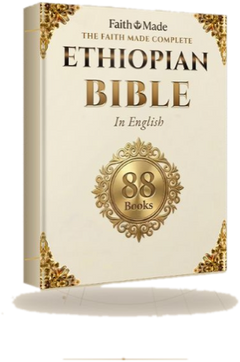
The Faith Made Complete Ethiopian Bible carries all 88 books in English, Enoch and Jubilees included, alongside the sixty-six you already have. You can read Matthew 24, then turn to the account it points back to, in the same volume.
Read the days Jesus pointed to
Where this comes from. A plain-language summary of published historical scholarship. Ancient dates and counts are reconstructions, and where scholars disagree this article says so. Scripture quotations are from the King James Version.